Showing posts with label Fun and Helpful Links. Show all posts

Monday, April 20, 2015

Fun and Helpful Links: Finals Edition

By Abby Ponder

It's both terrifying and exciting, but the semester is slowly but surely beginning to come to a close.

We're almost there...

...but so are those paper deadlines.

Stay calm, though. We'll get through this.

We've compiled a handy dandy list of links to help get you through this trying time. (Really, though, we have faith in you.)
  1. You need to outline your paper and don't know where to start? Here's an earlier post that covers just that! 
  2. You've got the topic, the outline is finished, but you can't seem to get in the writing zone. So, time to find a new writing place! 
  3. But if you're still struggling with procrastination, we've got just the post for you. 
  4. Research is a critical component in an academic paper, so make sure to utilize the WKU Libraries. 
  5. You've finally written that paper and now you need to edit it, so check out our post that offers some suggestions on that very topic. 
  6. You need to cite your paper? The Purdue Owl is a fantastic resource for checking on the various citation styles, specifically MLA, APA, and Chicago. 
  7. You've turned the paper in and are dealing with professor or peer feedback. Now what? 
And don't forget, the WKU Writing Center is here with you every step of the way. To schedule an appointment, give us a call at (270) 745-5719 or shoot us an email at writingcenter@wku.edu. You can also stop by and see us in our Cherry Hall location (Cherry 123) from 9-4 or at the reference desk in the Commons from 4-9.

So, remember:

Photo credit to this tumblr account that also highlights some additional stress release tips for finals week. 

Happy Writing! 

Monday, November 24, 2014

The Final(s) Countdown: Getting Your Paper Started

by Abby Ponder 

We've reached that time of year, folks: finals week. Or, better yet, crunch time.

It's been a grande ole' semester filled with football games and friends, festivities and fun times. But, like all good things, this semester has to come to a close, and with that conclusion, final projects and papers must come to an end, too.

So how are you coping with the stress of finals week?

Well, step one: don't panic. I know that is much easier said than done (trust me, I definitely know that), but it's doable. Compartmentalizing is key. I have four or five papers due in the upcoming weeks, and compartmentalizing them is the only way I'm going to be able to remain a fully functioning human being by the end of this.

So, let's walk through the process. Bear in mind that, as we go, what works for me may or may not work for you. Everyone has a different approach to paper writing, but it is my hope that even if this isn't the exact path you wind up taking, that this post might help you figure out for yourself what works and doesn't work, and then provide you the support to build your own foundation from there.

First, look at the assignment and deconstruct what it is asking you. Are there multiple questions being asked in the prompt? In that case, I've found that it can be helpful to separate them into different questions. Suppose that the prompt it asking you the following question: "How does The Scarlet Letter reflect the mentalities of Puritan New England? How is this mindset still reflected in a contemporary setting? How do the symbols from the novel reflect the way symbols are used today in regards to shame?" When planning to write this paper, you might break it down like this:


Admittedly, the questions your professors assign will be more eloquent than my attempts, and your answers will certainly be more elaborate, but you get the general idea. Breaking down these long questions can help you figure out what direction you want to take your paper in. I'm a very visual learner, and so having this clearly laid out in front of me helps tremendously.

However, while some assignments may be long and elaborate, there are others that are completely open-ended. In some cases, these assignments can be even more overwhelming. You know you're supposed to write about something, but with no specific guidelines or instructions, where on Earth are you supposed to begin? In that case, find a topic that is both interesting to you and is relevant to the class. Making a list can be helpful, and taking a look back at the syllabus can also give you an idea of everything you might've forgotten from earlier in the semester. (But you wouldn't forget any of the material, right?) 
Photo Credit 

Once you have a general idea as to what you're going to be writing about, I've found that writing up an outline can be particularly helpful. Outlines, in my experience, can go in a couple of different directions. 

One option is the bare-bones skeleton. This is the idea of just putting words on paper to have some sense of direction as to where the project should go. I typically write this outline on paper, because drawing arrows and crossing things out can sometimes be especially satisfying, and it definitely lends itself towards making you feel as if you're making progress--because you are! 


The above picture is from the beginning of an outline I was working on for a class earlier this semester. It's nothing terribly elaborate, but more of an idea as to where the paper will eventually go. Even if the paper deviates from this path, it's a nice way of gathering your thoughts and saving them for later. You never know what epiphanies will happen! 

Once I have finished my bare-bones outline, then I start a quote-based outline. In most of your academic research papers, secondary sources are crucial. Instead of flipping back and forth while writing the paper, I like to have a good idea of what quotes I'll be using and where I will be using them before I even get started. 

Following the bare-bones outline, I created this one to plug in resources that, if the paper presented an opportunity for them, I could cite. 

While you may still need to pull out some other quotes as you go along (because, hey, papers develop in different ways sometimes), this way you already have the central ones at your disposal. If you follow this outline (ha!), though, make sure you continue to mark where you're pulling the quotes from. Citations are critical, and you're not saving time in the long run if you have to go back and find the author and page number after the fact. Do it all upfront and you'll be golden! 

From there, the next thing to do is just start writing. And remember, the first draft doesn't have to be perfect--that's why it's called a first draft. If you have the time, check out one of our recent post about the editing process for some extra assurance and advice. 

Also, don't forget that the Writing Center is here to assist you with any stage of the writing process. We are not an editing service, but we will gladly help walk you through any bumps in the road you may stumble across, whether you're on the preliminary outline or looking at a final draft. Sometimes it's just nice to have a second opinion on things, too. 

Like always, you can schedule an appointment by clicking here and selecting a time that works well for you. If you're struggling with the system, we also offer a step-by-step tutorial for how to make an appointment. We are also available for drop-in appointments, but please remember that those function under a first come, first serve basis. Because of that, we strongly encourage students to go ahead and schedule an appointment in advance to secure their spot. 

Good luck in the upcoming couple of weeks, my friends, and have a wonderful break! 

Happy Writing! 


Wednesday, November 19, 2014

Scheduling Appointments: The How-To Edition

by Abby Ponder 

We’re beginning to get into crunch time, and so now, more than ever, we strongly encourage students to schedule their appointments with the Writing Center in advance.

If you’re struggling with scheduling your appointment online, follow this step-by-step guide to scheduling success!

Step One: Visit our website at www.wku.edu/writingcenter.


Step Two: Once on our website, scroll down until you see the option to “Schedule an Appointment.”


Step Three: Once you have clicked on the “Appointment Scheduler” link, you will be taken to the login page for TutorTrac. On this screen, you’ll enter your WKU NetID (not your 800#) and password.


Step Four: Once you’re logged in, move your mouse to hover over the “Go To…” tab. From there, you’ll click “Make Appointment.”


Step Five: Once you’ve clicked on “Make Appointment,” you’ll be taken to a screen where it will ask you to request a Center on the right side of the page. You might have to scroll down a little bit to see the Writing Center option. Once you see it, click on it and then hit “search.” (Don’t worry about looking at the options to select tutors and dates that are located on the lefthand side of the screen.)


Step Six: Once you have hit “Search,” scroll down to the bottom of the page. You will see all the names of the tutors, as well as the times they have appointments available. If you are able to click on a time slot—success! You’re well on your way! If the time you would like is not a clickable link, then that time is not available for appointment. 


Step Seven: After you have clicked on a time, you'll be taken to a screen where you schedule your appointment, and then you’re all set! You should immediately get an email confirmation from us that your appointment was scheduled.


Step Eight: Show up for your appointment! The day before your scheduled time, you should get a reminder email that your appointment is approaching. Students should bring with them a draft (or any work they have completed thus far) and, if they have it, a copy of the prompt. 

If you have any additional concerns about scheduling an appointment, we also have a handy dandy tutorial video to help guide you through the process. 

If you have any additional questions, you can email us at writingcenter@wku.edu or give us a call at (270) 745-5719. 

We look forward to seeing you at your (newly scheduled) Writing Center appointment! 

Happy Writing! 

Monday, November 10, 2014

STEPS: Making a Difference in Literary Analysis Papers

The WKU Writing Center would like to announce an up-and-coming resource for students to utilize when writing literary analysis papers. 


STEPS (Students Teaching English Paper Strategies) is a web site designed to help students write good papers about literature. This site is constructed for students, by students, and provides a doable process for analyzing literature and writing about it. STEPS helps students identify literary devices, determine the themes of literary texts, develop thesis statements, and produce successful essays. The site is filled with sample essays, peer reviews, and processing notes for each step. Students will also find a helpful glossary of literary terms, with examples from various works, and links to additional writing resources. Please visit www.writingaboutliterature.com for more information.

For students taking English classes (both in or out of the major), STEPS provides relevant information for the various stages of the writing process. Sometimes, as a writer, you just get stuck and there's no real conceivable way to get out of the writing funk. However, just searching through some of the tabs on the site, I've found them to be very helpful at finding ways to propel the process along. Sometimes just reading about writing can get you ready to start writing. It's funny how that works sometimes...

There are two tabs that I found particularly helpful, as well. The "Process and Methods" and the "Resources" (the "Archives" section especially) tabs are both excellent tools to utilize. The latter section, the Archives, even has example papers and the writing process therein. Every person has their own writing (and editing) style(s), and it can be beneficial to see what works for someone else, and then try to apply similar techniques. 

The STEPS homepage.
So, whether you're stuck finding a starting point, or if you're just looking to improve your writing, we definitely encourage you to check out STEPS. The site is still in its beta-form, too, so be sure to leave any feedback you think might be helpful. 

Happy Writing! 

Monday, October 20, 2014

"Red, the blood of angry pens; black, the marks of mistakes past..."

by Abby Ponder 

For almost all writers, editing is a fundamental aspect of the writing process. Without it, mistakes can be glossed over and points can remain unrefined. And while in a lot of cases editing is no one's idea of a good time, it certainly doesn't have to be the nightmare most people make it out to be.

Whenever I'm writing, my first draft is, to put it rather bluntly, a bit rough. Actually, it's more than a bit; it's generally so rough that I almost always refuse to let anyone else even glance at it. My first draft is usually a compilation of various outlines (a step outlined in a recent post) that have been tossed together into an assortment of paragraphs that are usually long and rambling with very little cohesion. It's something resembling a paper, but it's not there yet. Like I said, these initial drafts are rough--but that's okay.

Anne Lamott, most known for her novel Bird by Bird which highlights tips for successful writers of all genres, has a chapter in the aforementioned novel called "Shitty First Drafts." In the chapter, Lamott explains that a first draft is just that: a first draft. It doesn't have to be perfect, but it is a starting point. The whole point of the first draft is to get words and ideas on paper, after all, and that is almost always the hardest part of writing: you have all these fantastic ideas, but you might not have a specific place to start or a way to tie them all together. However, between the help of your outline and your "shitty first draft," you'll begin to have an idea come together and slowly but surely that idea will begin to blossom.

So, after you've written that first draft, some people write another one... and then maybe another one after that. I know that I usually go through several drafts before I am finally satisfied.

My British Fantasy Literature paper rocking some Les Miserables lyrics, as one naturally does. 
For example, I took a class last fall where I had to write a paper breaking down the concept of love in works of British Fantasy Literature. (Harry Potter was, unsurprisingly, incorporated into this assignment.) However, even though I intimately knew the subject matter, there were still a number of changes that needed to be made. A friend of mine helped me to put the editing process in perspective, made me take a step back and laugh at it, and the break from the seriousness was a tremendous help. 

Editing, in my experience, is mostly about taking that step back and examining what the words staring back at you are trying to say. It's akin to reading another person: they're trying to say something, but it is up to you to decipher the meaning. 

There are two things that I have found incredibly helpful in the editing process: (1) printing off the paper, and (2) reading it out loud. 

While it is easy enough to edit a paper on the computer (and, admittedly, it does save some on printing costs), there is something about editing a paper on, well, paper that makes a huge difference. People tend to be more inclined to skim when reading online, and consequently it can be very easy to skip over the small mistakes--especially when you're not on the hunt for a misplaced pronoun or a comma splice. When you print the paper out and literally put pen to paper, you'll be surprised at how many things you see. And, like with my paper above, there is a sense of accomplishment that comes from seeing a marked up paper. Sure, it means you still have a ways to go, but it also symbolizes progress, and progress is never a bad thing.

Next, reading the text to yourself (or another person) can alter your perception of the words. Reading aloud forces you to interact with the paper and actively think about both the content and the style. Additionally, most people have a tendency to catch any misplaced words or confusing phrases when they're hearing or speaking them. What sounds good in your head may not always work out loud, and this step can do a lot in terms of drawing attention to that. 

Just make sure that whenever it seems like too much, and you feel as though you can't make sense of the words anymore, take a break. Sometimes you need to give your brain some room to breath, and then you can come back ready to get back to work. 
Comic by Debbie Ohi. 
When you feel like you're finished, though, or even if you're stumped along the way, don't forget to utilize the WKU Writing Center. While we are not an editing service, we will help walk you through any bumps in the road you may be having. Sometimes it's nice to have a second opinion on things, too. 

As always, you can schedule an appointment by clicking here and selecting a time that works well for you. We are also available for drop-in appointments, but those function under a first come, first serve basis.

Happy Writing! 

Monday, October 6, 2014

Understanding Your WKU Library and the Looming Research Project

by Abby Ponder 

Well, we're all back from Fall Break now (or, at least, most of us are) and that can only mean one thing: those mid-term and final deadlines that initially seemed so far away? They're approaching--fast. And for a lot of students, that final project will be coming in the form of a research paper. (But have no fear, the Writing Center is here!)

So, you're staring at this blank slate of an assignment with no clue what to do next. You have a topic, maybe, but all that supporting research? Where are you supposed to get it? Well, my friend, the library is your new best friend when it comes to getting started on your research. There are floors upon floors of shelves upon shelves, and lots of friendly people there to assist you along the way. Books are unfortunately becoming an underutilized resource so make sure you take the time to utilize them; you can find a lot of great information in between the lines.

Remember these guys? They knew to search between the lions.
Photo courtesy of Mississippi Kids Count (http://goo.gl/BDnxAm)
If you haven't paid a visit to WKU's very own library yet (Helms-Cravens), it is located in the center of WKU's campus between Grise and Garrett. If you've ever visited Java City for a quick caffeine fix, you're in the right place! Just travel through the Confucius Institute and you're in library territory. (Or enter through the Commons at Cravens, located between FAC and Grice.) If you're not on main campus, though, the regional campuses each have their own libraries, too.

However, we know that getting into the library isn't always an option. In that case, the WKU library has extensive online databases at your disposal. On the library homepage there is an option to explore Electronic Resources. In most cases, students will use the Databases option, though there are a variety of others to explore, too. Once you're in the Databases, you can opt to use EBSCOHost, Jstore, Newstand, etc. (If you are not using a university computer you may be prompted to enter your NetID and password, but from then on you'll have complete access.) From that point, you'll be able to search to your heart's content. 

The search engine for EBSCOHost, which can be found here.
After you have found your treasured resources, whether they be books from the library or journals collected via some of the databases, there are a variety of citation formats to be aware of that depend on the style guide in question (MLA, APA, Chicago, etc) and the source that you're using (online journals, novels, newspapers, etc). For a quick look at the more common style guides, the Purdue Owl has some great guides to MLA, APA , and AP, while the Chicago Manuel of Style has its very own guide available on its website.

Throughout the whole process, though, don't forget that the WKU Writing Center is here to assist you along the way! We encourage you to schedule an appointment with us at your convenience, but we are also available for drop-in appointments on a first come, first serve basis.

Happy Writing! 

Thursday, March 20, 2014

Verb Tenses

Lately, many tutors in the Writing Center have noticed students coming in with papers that display issues with verb tense. In this post, I will go over the basic verb tenses and how and when to use each.

There are six basic tenses in English, but only past and present require a change to the spelling of the verb. The others add a word or words (auxiliaries) to create the desired tense. The six tenses are simple present, present perfect, simple past, past perfect, future, and future perfect.

Simple Present
Verb: to walk
  • I walk.
  • You walk.
  • He/she/it walks.
  • We walk.
  • They walk.
Simple present is the most basic verb tense. It is used to describe something that is happening in the present, i.e. right now. Note the difference in the conjugation for he, she, and it. Instead of "walk," the verb is "walks." This is because "he, she, and it" are in the singular form, while "they," for instance, is plural.

Present Perfect
Verb: to jump
  • I have jumped.
  • You have jumped.
  • He/she/it has jumped.
  • We have jumped.
  • They have jumped.
The present perfect tense is used to describe completed actions that have consequences in the present. While the jump in the examples happened in the past, something about them is affecting the present state of the speaker. Again, note the singular form for he, she, and it.

Simple Past
Verb: to talk
  • I talked.
  • You talked.
  • He/she/it talked.
  • We talked.
  • They talked.
 The simple past is the basic form of past tense. It is used to describe something that was completed in the past and is not happening now. Conjugations are the same for all subjects.

Past Perfect
Verb: to wash
  • I had washed.
  • You had washed.
  • He/she/it had washed.
  • We had washed.
  • They had washed.
The past perfect tense is used when describing an event in the past that happened before other events in the past, as in I had woken up just before my alarm went off. Conjugations are the same for all subjects.

Future
Verb: to go
  • I will go.
  • You will go.
  • He/she/it will go.
  • We will go.
  • They will go.
The future tense is used to describe something that has not happened but will happen in the future. In the examples, the subjects have not gone yet, but they are planning to go. Conjugations are the same for all subjects.

Future Perfect
Verb: to see
  • I will have seen.
  • You will have seen.
  • He/she/it will have seen.
  • We will have seen.
  • They will have seen.
The future perfect tense is used to describe something that will have happened by a certain time or point in the future, as in I will have seen the Great Wall of China by the time I am old. Conjugations are the same for all subjects.

In academic writing, it is important to remember when to use each tense. Present tenses are used to describe events that are currently happening, while past tenses are used to describe events that have already happened and future tenses are used to describe events that are going to happen. In most academic work, it is important to remain consistent in your verb tense throughout the paper, usually sticking to either all past or all present tense. However, it is acceptable to interchange the tenses when speaking about separate events that happened in either the past or the present--it is not acceptable, though, to change the tense within the same sentence. It is also important to remember that when writing about literature, you must always refer to the events of the text in the present tense. This is because those events will still be taking place in the text any time the reader looks at it. Those events never end because the text is in a constant state of existence.

We hope this helps clear up any confusion about verb tenses, but if you ave any questions, please stop by and see us in the Writing Center. We would be more than happy to assist you. You can also visit the "verb tenses" link in the first paragraph for more help.

Happy First Day of Spring!

--Sarah

Friday, October 25, 2013

The Importance of Voice

I have been seeing a lot of papers in the Writing Center recently that are struggling with one of the most important components of writing: voice. Voice lets the reader connect with what the writer is saying, puts passion into a (possibly) bland topic, and demands the attention of the reader.

But what is voice? And how does it work?

Voice is the unique way that everyone thinks and speaks. If you can talk, you can write. However, based on the papers I have been reading lately, everyone else seems to think there is a "perfect voice" out there that every professor expects you to use.

This is not true.

The best thing you can do for your writing is to write the words that you think. Just write exactly the way you would explain the same thing to a friend, an acquaintance, or a professor. Academic writing does need to be formal to an extent, but it doesn't have to strangle your voice out of the words. When you are writing an essay, write it in a way that would be interesting for you. Don't just regurgitate what you think the professor wants you to say. That cheats you from a good writing experience, and it cheats your readers from a pleasant reading experience.

I know what you're thinking. What about a formal tone? What if my voice doesn't sound smart enough?

To which I respond, who cares? Formal tone does not mean "stuffy," "boring," or "smart-sounding." Think of formal tone as the way you would talk to a professor or your boss or the president. When talking to those people, you may be more conscious of conventions and grammar, but you don't completely change the way that you form sentences and ideas.

Also, where does this idea about having to sound smart come from? What does that even mean? If you sound like yourself and you know what you're talking about, you will come across as knowledgeable in the paper. But the point of an essay is not to sound smart. The point of an essay is to propose an idea and back up that idea with evidence. Do you have ideas? Do you have evidence? If the answer is "yes," then you have a good paper.

All that you need now is your voice.

Sit down and write your idea and the evidence you have for it. Just write it in a list. Then, connect the evidence to the idea. How did the evidence help you come up with the idea? How will the evidence help you explain the idea to someone else? Just write all this down exactly as you would if no one were ever going to see it. Slap on an introduction to the context, turn the idea into a thesis, and cap it off with a conclusion that sums up the idea and the evidence, and you have your first draft written in your own voice.

Now go back and edit for formality. Make sure your grammar and punctuation are perfect. Take out all the phrases you wouldn't say to the president, and you are one step away from your final copy. All that's left is to talk about this with a tutor in the Writing Center, and you are ready to turn that bad boy in.

I understand how difficult it is to find your voice in your writing. It is something I struggle with as a writer in my academic work. People think voice is just for creative writing or that they aren't supposed to use their own voice in essays, but neither is true. Putting a bit of yourself into a paper is the best thing you can do for it. More people will be able to relate to what you say, and they will be more likely to forgive grammar mistakes or cliche phrases if they can get some personality out of a piece.

Bottom line: Don't try to be the perfect writer; just try to put yourself on paper.

If you are still having trouble finding your voice, I urge you to read Jeff Goins' blog post "10 Steps to Finding Your Writing Voice." He provides a great exercise that can help you recognize your voice ad put it into your writing.

Best of luck,

--Sarah

Sunday, September 29, 2013

Grammar, Grammar, Grammar!

Happy Sunday everyone!

One of the biggest things we're always getting asked about at the Writing Center is grammar.  This should surprise absolutely no one, since English grammar is pounded into our brains from the moment we step into kindergarten until...well, to be honest, people will never stop hounding us about our grammar.

If your first language is English, you're lucky enough to have what's called "native speaker intuition," meaning you can spot and hear major grammatical mistakes, often without being able to explain WHY you know it's wrong.  However, this doesn't often cross over to smaller grammatical aspects, such as homophones, punctuation, and verb tense.  If English isn't your first language, well, you're learning with the rest of us!

But let's get real here, you say, when does knowing the difference between affect and effect become obvious in a conversation between two friends?  When is your mom going to notice if you don't put a semicolon between two independent-but-tightly-related-like-that-one-annoying-couple-you-know clauses?  The quick answer: it won't!

And yet, we've all got that friend who corrects grammar on Facebook.  We all had that eighth grade teacher who drilled subject-verb agreement into our heads.  So what's the big deal?

It's easy to believe that grammar doesn't matter at all, but it's not a very practical opinion.  English, like every other language, has grammatical structures that are unique and essential to it.  These grammatical structures mean the difference between saying something like "I ate dinner with my dog," to "I ate my dog with dinner."  (Sorry Fido!)

Although it may seem easy to write off ALL grammar, the fact of the matter is, you need grammar to communicate.  Sure, it might still be readable if you use the wrong form of a word, but it will take away from your meaning.  And less meaning means less effectiveness.  And, in the end, less effectiveness may tell some readers that you are less intelligent, less worthy, less important.

THIS IS NOT THE CASE.  

You are a intelligent individual, regardless of your educational training, and you should be able to use whatever language is needed to make a strong and effective point in any situation.  It's easy to think of grammar as a punishment, but try thinking of it as a tool instead.  When having a debate on Facebook with a friend, your grammar doesn't matter, but your content does.  However, in academic writing, both are equally important.  Your content may be fresh and powerful, but if your delivery lacks, readers may be confused or even turned off by your paper.

This isn't just an English skill.  You will have to write papers for every aspect of your life.  You will apply for things, you will write romantic/funny/friendly things, you will NEED to have the skills that will allow you to pound out a few amazing and effective sentences on a page instead of a mash of text speak.  Sometimes text speak is amazing.  Sometimes it's not.  That's just a fact of our lives.  So, learning grammatical points and knowing which situations to use them in is a key skill to developing yourself not just as a writer, but also as an individual.

With this in mind, I recommend Grammar Girl's wide array of grammatical lessons.

Mignon (like the filet, but much funnier) publishes tips and tricks under a wide variety of methods.  She has a blog, she has a podcast, she has an APPLE IPOD APP (how cool is that?!).  She is here to help you, not to preach a rule or slap your hand with a ruler.  Her topics range from homophone usage to comma splices to silly English idioms and where they come from.

Grammar Girl (and the WKU Writing Center) are here to help you kick grammar's butt!  Take advantage of that!

--Teresa  

Wednesday, December 14, 2011

Fun and Helpful Grammar Links

I could have focused on one site in particular, but I found several that I like and think are beneficial for writing. 
Everyone thinks their grammar is terrible.  The thing is, we learn things in elementary school and they don't necessarily stay in our head.  So here are some helpful links for you are having grammar problems.
You Tube Preposition Video - This is a song of the prepositions, alphabetized and sung to the tune of "The Mickey Mouse Club March."  You'll never forget which words are prepositions again!
Conjunction Junction You Tube - I had to bring back some Schoolhouse Rock!  This video is not only informative, but if you grew up watching Schoolhouse Rock, it brings back memories.

Hope these links help!  Enjoy!

- Kayla

Friday, December 9, 2011

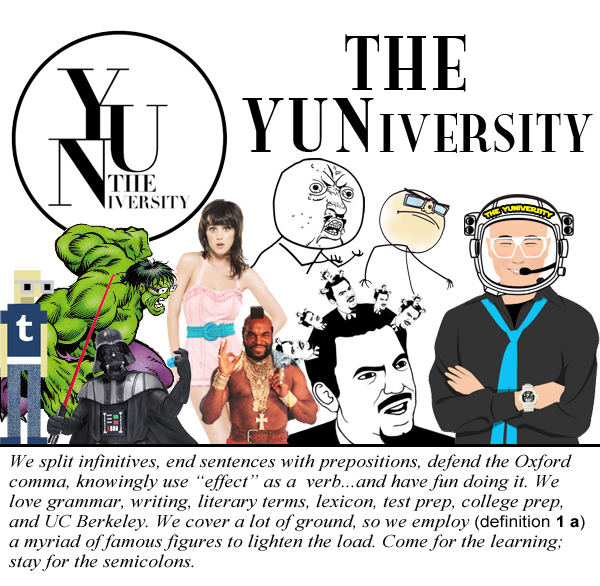
The YUNiversity: Making Proper Writing Skills FUN and EDUCATIONAL

The YUNiversity is one of my favorite Tumblr sites to visit.  To those not too familiar with Tumblr, it is a social network that allows its users to create and disclose themed blogs with the web-world.  Its main function is to serve as an interactive weblog that gives its users the opportunity to share and even reblog photos, quotes, weblinks, articles, journal entries, music and videos.  Tumblr sites can include helpful tips on literary theories, webcam reviews on books, and commentaries on movies and TV shows—the possibilities are endless.  In regards to writing, The YUNiversity is one of the most entertaining, but helpful Tumblr sites that I have come across. 

The YUNiversity is dedicated to answering online questions submitted by their followers. These questions refer to grammatical and mechanical writing errors, common word usage, and numerous other concerns referring to the English language. The questions are answered promptly in an entertaining, but informative format. The YUNiversity commonly uses cartoons and pop cultural references, and incorporates them into their answers. These fun pictures allow the audience to easily understand and relate to the explanations of the questions. 

Be sure to drop by this site for references and answers related to one of your writing assignments. I guarantee you will be satisfied and entertained with The YUNiversity. 

Have fun!
~Cassie 

Thursday, December 8, 2011

Oatmeal: Not Just a Super Food, but a Super Site!

I was introduced to The Oatmeal on Valentine's Day 2011. Someone had posted something ridiculous on Facebook, so after I stopped laughing, retweeted  it, and the like, I curiously clicked the link to see what else I was missing out on. What did I find?

The best freakin' site ever!*
   *slight exaggeration, but it's still pretty great!


With The Oatmeal you can find all sorts of things to not only learn, but have fun with. My personal favorites involve anything grammar related [and not simply because I'm an English person] because they go above and beyond to make sure 1) they're funny and 2) you remember. It kind of reminds me of the days we got to watch School House Rock! in class: it's fun, it's educational, and we don't feel like total dweebs for liking it.

Some fun grammar quizzes can be found here. Okay, so they're not really quizzes, just comical ways of telling the site visitor about the proper use of a semi-colon [use it, people!], how to correctly use an appostrophe [because, to this very day, they confuse me], and so on. They're fun "quizzes" so it doesn't feel like a chore to take two minutes out of your day to take one or two just to refresh your memory. Trust me, our college-age memories always need a nice refresher course, and if we can laugh while we learn? Well, I'm sold.

So check it out and refresh your memory on some grammar. And while you're at it, poke around on the site. Some of the stuff is better than others [and the line of "offensive" is tread not so carefully], so let's keep this amongst our college age pals, shall we?  

-Olivia!

Tuesday, December 6, 2011

Helpful Resources: Grammar/Writing Quizzes

I have recently discovered a very useful website for anyone wishing to improve their grammar or writing skills. The link that follows leads to a direct page with interactive grammar and writing quizzes. The site not only allows you to take the quizzes to test your knowledge, but it directly explains the errors made and why the answer was correct or incorrect. The website was created by very reputable sources, and has contributions from textbooks, various professors of English across the nation, and specifically, Professor Karyn Hollis's Tutor Training course at Villanova University. The quizzes address several grammar issues, including pronoun usage, clauses and phrases, structural flaws, etc. However, there are also quizzes regarding spelling, punctuation, vocabulary, stylistic considerations, etc. One of the greatest aspects of this page is that at the top of it, there is a drop-box where you can select from over fifty grammar and writing rules or receive assistance with unfamiliar terms. After clicking on the specific area you need help with, you will be redirected to a page that explains the grammar term, punctuation, or writing-specific aspect, and the page will have a definition, explanation, and links to quizzes.  

Here is the link to this wonderful resource:
Guide to Grammar and Writing: Interactive Quizzes

Happy learning!
-Bethany

Thursday, November 3, 2011

What's All the Hoot About? Why We Recommend The Purdue OWL

Provided by Liz Noffsinger and freedigitalphotos.net
You might have heard of the Purdue OWL, or Online Writing Lab, from your tutor, your professor, and your especially studious friends.  So what's with all the fuss about this website? 
Simply put, The Purdue OWL is one of the best and most comprehensive guides to writing English papers ever made, online or otherwise.  You need help with the ever-changing MLA format? The Owl's got that. Confused by comma rules? Yeah, they got that covered.

Speaking in a more serious manner, The Purdue OWL talks about complicated issues like MLA citation in a clear and readable way. They have great diagrams and interactive memory tools that are especially made for college students' use.  We might have other blog entries covering more specific tools in the OWL, but until then, explore The Purdue OWL on your own. Be warned though, like TV Tropes, the OWL can be addictive.  Don't blame us if you spend way too much time reading about commas... Enjoy!

Happy Writing,
 Geneva